
Key Takeaways
- Office space for nurse practitioners in New Jersey is in higher demand since March 2026, when the state made independent practice permanent for qualifying APNs in primary and behavioral health care.
- Most solo NP practices operate comfortably in 180 to 240 square feet. Size the suite to your visit type, not to what a commercial broker shows you.
- Confirm your practice authority status before signing anything. Whether you need a joint protocol changes your staffing, your costs, and your timeline.
Office Space for Nurse Practitioners in New Jersey: A Market That Just Shifted
Demand for office space for nurse practitioners in New Jersey moved noticeably in 2026, and the reason is regulatory rather than economic. On March 30, 2026, Governor Sherrill signed legislation making independent practice permanent for certain advanced practice nurses providing primary or behavioral health care, and allowing qualifying APNs to prescribe medications without a joint protocol with a collaborating physician, according to the Governor’s office announcement.
The change arrived after a period of genuine uncertainty. Executive Order 415 ended the pandemic-era waiver that had allowed APNs to prescribe without a joint protocol, with the wind-down completing in February 2026, as a Frier Levitt analysis of the order documented at the time. Several weeks of reduced authority followed before the new law restored and extended it for qualifying practitioners.
For NPs who had been weighing independent practice, the sequence resolved the biggest open question. Practice ownership stopped being contingent on an executive order that could lapse.
Who Is Opening Practices Right Now
The tenant profile in northern New Jersey has shifted accordingly:
- Family and adult primary care NPs opening panel-based practices
- Psychiatric mental health NPs running medication management and therapy practices
- Women’s health NPs offering well-visits, screening, and counseling
- NPs in specialty consultation roles who left hospital employment
- Aesthetic NPs practicing under medical licensure rather than cosmetology credentials
- Two-NP partnerships splitting a suite or taking adjacent ones
Behavioral health is the most active category. Demand for psychiatric prescribers in Bergen County substantially exceeds supply, and a PMHNP with a cash-pay or hybrid model can fill a schedule faster than nearly any other independent practice type.
Verify Your Status Before You Sign
The exemption is tied to qualifying criteria and to practicing within covered primary or behavioral health settings. APNs who do not qualify, or who practice outside those settings, should continue to use a written joint protocol when prescribing or ordering medications or devices.
Where you land changes real numbers. A joint protocol means recurring collaborating-physician costs, ongoing documentation, and a relationship you have to maintain. Confirm your specific position with the New Jersey Board of Nursing before you commit to a lease, since the answer affects what you can afford monthly.
Sizing the Suite to Your Visit Type
Nurse practitioners consistently tour space that is larger than their practice requires. A commercial broker shows a 900 square foot unit because that is the inventory built for a different tenant.
What Each Practice Type Needs
| Practice type | Working size | Key requirement |
| Behavioral health / psychiatry | 180–240 sq ft | Sound privacy above all |
| Primary care, consultation-heavy | 180–240 sq ft | Exam table plus seating |
| Primary care with point-of-care testing | 240–350 sq ft | Sink, counter, storage |
| Women’s health | 240–350 sq ft | Exam privacy, equipment room |
| Aesthetic practice | 240–470 sq ft | Sink, power capacity, storage |
| Two-provider practice | Double suite or two singles | Scheduling independence |
A single suite at 180 to 240 square feet handles a full day of visits without strain for most solo NPs. Doubles at 325 to 470 cover procedural work, equipment-heavy practices, and multi-provider setups. Inventory at SADA Med Suites spans both ranges, which is the useful bracket for practices at this stage.
Why Smaller Usually Wins Early
Rent obligation begins immediately. Patient volume does not. An NP building a panel from scratch typically needs six to twelve months to fill a schedule, and every extra square foot compounds across that window.
Outgrowing a single suite in eighteen months is a good problem. Carrying a double you cannot fill for three years is the outcome that closes practices. Our comparison of medical office rental versus leasing covers the structural difference between the two commitments.
What the Room Needs to Support Clinical Work
Beyond square footage, a handful of physical features determine whether a suite works day to day.
Plumbing and Power
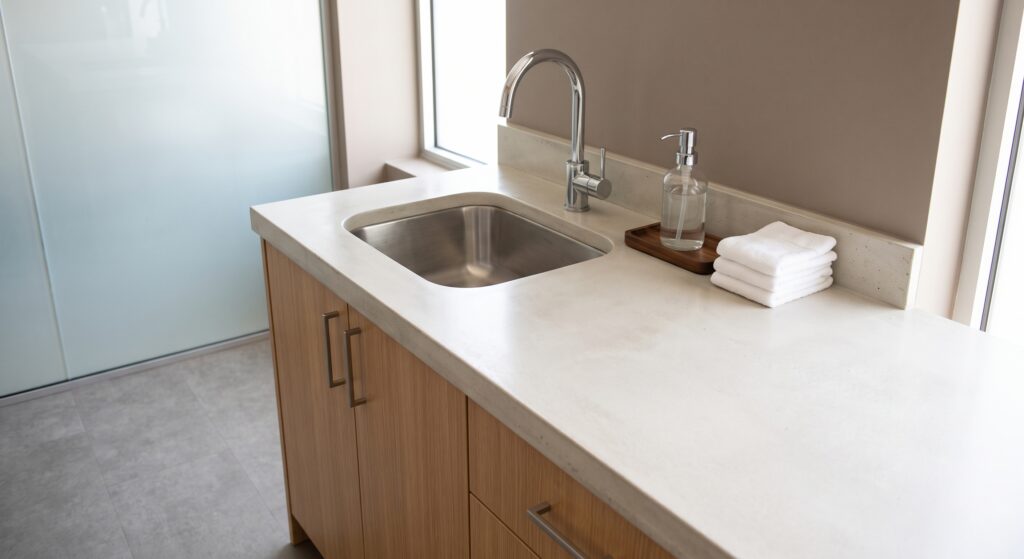
An in-suite sink changes your workflow completely. Hand hygiene between every patient means leaving the room and walking a corridor forty times a day without one. Confirm hot water arrives at the tap within a reasonable wait rather than accepting that a faucet exists.
Electrical capacity deserves the same attention. A laptop, printer, point-of-care equipment, exam lighting, and a space heater on one circuit will trip a breaker mid-visit. Ask which outlets share circuits and whether a dedicated line can be added.
Storage and Layout
Supplies, medication samples where applicable, linens, and records all need secure homes. An exam table, rolling stool, provider chair, patient seating, and a work surface consume floor space faster than a diagram suggests. Measure against your actual equipment list before signing.
Lockable storage matters for both compliance and practicality. Confirm you can install your own locks on cabinets and closets.
Sound Privacy
Behavioral health practices live or die on this. Stand in the suite while someone speaks at conversational volume with the door closed, then listen from the corridor and from the waiting area. Words you can make out are a failure.
Solid-core doors with seals and sweeps address more transmission than most wall treatments. A white noise machine outside the door handles the rest. Negotiate a door upgrade before you sign rather than after.
Compliance in a Multi-Tenant Building
Renting inside a shared building raises questions a standalone office never does. The HIPAA Security Rule requires physical safeguards limiting access to systems and facilities housing electronic protected health information, and the HHS summary of the Security Rule covers facility access controls, workstation security, and device and media controls.
Ask the landlord directly:
- Who holds access credentials to your suite, and is entry logged?
- Does cleaning staff enter your suite, and during what hours?
- Is the WiFi network shared with other tenants, and can you get a private connection?
- Can you install your own locks on storage?
- Does a video intercom let you control who enters the building?
Waste handling needs a separate conversation. General commercial landlords frequently have no arrangement for regulated waste, which leaves you contracting independently. Settle it before move-in.
Controlled substance storage, if your practice involves it, requires its own security review against DEA requirements. Confirm the suite supports what your registration will demand.
Building the Business Around the Space
Space is one line item in a longer sequence, and getting the order right saves months.
Order of Operations
- Confirm licensure and APN certification are active and in good standing
- Establish your practice authority status — exempt or joint protocol required
- Secure a collaborating physician if applicable, before anything else depends on it
- Form the business entity and obtain an EIN
- Obtain malpractice coverage written for independent practice
- Sign the lease — credentialing needs an address
- Begin insurance panel applications immediately
- Register for CDS and DEA at the practice address if you prescribe
- Set up practice management and EHR software
Credentialing is the long pole. Panel applications routinely run three to six months, and every one of them requires a practice address, which is why the lease sits ahead of them in the sequence rather than behind.
Cash-Pay Changes the Math
NPs opening behavioral health and aesthetic practices increasingly skip insurance entirely, and the decision reshapes the timeline. Without credentialing, you can see patients the week you open. Without insurance reimbursement, you need a referral strategy and a fee patients will pay directly.
Bergen County supports cash-pay models better than most markets. Household incomes run well above state and national medians, and demand for psychiatric prescribers is high enough that waitlists form quickly. Our breakdown of what it costs to open a medical office in New Jersey covers the figures behind both models.
Lease Terms Worth Negotiating
Independent NPs are new tenants with no operating history, which is a weak negotiating position on paper and a stronger one in practice — landlords with small suites want reliable professional tenants.
Ask for:
- Early termination without penalty, or with a capped and clearly stated fee
- Right of first refusal on an adjacent suite so growth doesn’t force a move
- Transfer rights between suite sizes in the same building
- Part-time arrangements if you’re opening alongside a W-2 position
- Delivery condition documented in writing, including any landlord work
- Signage on the suite door and building directory
- After-hours access confirmed in the lease, not verbally
Evening availability deserves specific attention. A large share of primary care and behavioral health demand comes from patients working standard hours. A building that locks at six eliminates your most requested slots.
Location Factors That Affect Panel Growth
Where you practice shapes who finds you and whether they return.
Referral Proximity
Referral flow follows geography. Being within a short drive of primary care offices, pediatric practices, urgent care, and therapy practices produces referrals that never materialize twenty minutes further out. A building housing other independent providers generates the same effect internally — our provider directory shows the kind of mix that supports it.
Parking and Access
Patients evaluate an appointment on total friction. Ten minutes circling for parking turns a monthly visit into a quarterly one. Walk the block at the hours your patients would arrive, check the path from parking to your door, and confirm elevator access for older patients and anyone with mobility limitations.
Search Visibility
A Google Business Profile at your practice address takes months to mature in local rankings. Establishing it the week you sign, rather than the week you open, moves your visibility timeline forward meaningfully. Our post on why Englewood works as a practice location covers the demographic and access picture for the area.
Frequently Asked Questions
Can nurse practitioners practice independently in New Jersey?
Legislation signed on March 30, 2026 made independent practice permanent for certain APNs providing primary or behavioral health care, and allows qualifying APNs to prescribe without a joint protocol. Eligibility is tied to specific criteria and to practicing within covered settings. Confirm your status with the New Jersey Board of Nursing before making business decisions around it.
Do I still need a collaborating physician?
Depends on whether you qualify for the exemption and whether your practice falls within the covered primary or behavioral health settings. APNs outside those parameters should continue using a written joint protocol when prescribing or ordering medications or devices.
How much office space does a solo nurse practitioner need?
Most solo practices work well in 180 to 240 square feet, which fits an exam table, patient seating, a work surface, and storage. Practices with point-of-care testing, procedural work, or significant equipment generally need 240 to 350 square feet or a double suite.
Does New Jersey set a minimum office size for an NP practice?
No board imposes a square footage requirement on a nurse practitioner office. Your obligations concern licensure, certification, scope of practice, prescriptive authority, and recordkeeping rather than facility dimensions.
How long before an NP practice becomes profitable?
Filling a panel from a standing start typically takes six to twelve months. Cash-pay practices in high-demand specialties, particularly behavioral health, often ramp faster because credentialing doesn’t gate the start date.
Can two nurse practitioners share one suite?
Yes, and splitting days or hours is common among practitioners starting part-time. Document the schedule, storage division, and payment structure in writing, and confirm the lease permits the arrangement before committing.
What should I ask a landlord about HIPAA compliance?
Ask who holds suite access credentials and whether entry is logged, whether cleaning staff enter and when, whether the network is shared or private, whether you can add your own locks, and how patient entry into the building is controlled.
Do I need my own malpractice insurance?
Yes. A landlord’s policy covers the building, not your clinical practice. Independent practice requires coverage written for that structure, which differs from what an employer policy provided.
About SADA Med Suites
SADA Med Suites rents private, fully furnished medical office suites to independently licensed practitioners in downtown Englewood, New Jersey. Singles of 180 to 240 square feet handle a full day of visits; doubles of 325 to 470 support procedural work and two-provider practices. Utilities, internet, cleaning, waiting area, secure 24/7 access, and suite signage are included.
Nurse practitioners opening independent practices need an address before credentialing begins, and a lease that doesn’t outlast their certainty about the model. Our terms are built for practices in their first years.
Take a look. Find your suite or book a tour. Call (201) 408-4793 — 50 E Palisade Ave, Fl 2, Englewood, NJ 07631.