
Key Takeaways
- Therapy office space for rent in Bergen County, NJ rarely needs to be large — most solo clinicians work comfortably in 180 to 240 square feet, and the money saved goes further than extra floor area ever would.
- Sound privacy and waiting room flow decide whether a suite works clinically. Test both during the tour, not after you sign.
- Match lease length to how long filling your caseload will realistically take. Six to twelve months of ramp is normal for a new private practice.
Therapy Office Space for Rent in Bergen County, NJ: What the Search Involves
Searching for therapy office space for rent in Bergen County, NJ turns up commercial listings written for a different kind of tenant. Brokers show 900 square foot units with bare walls, a shared corridor, and an expectation of a multi-year term plus a buildout budget. A clinician seeing 20 clients a week needs almost none of that.
A working therapy room requires a door that closes, two comfortable chairs, controllable light, and a waiting area that doesn’t seat two clients across from each other. Everything beyond that list is preference, and preference gets expensive fast when you’re paying for it monthly during your first year.
Who Rents Small Clinical Suites in North Jersey
The tenant profile in Bergen County skews heavily toward practitioners who left agency, hospital, or group practice work:
- Licensed Clinical Social Workers building an independent caseload after years in community or hospital settings
- Licensed Professional Counselors and associate counselors accruing supervised hours toward full licensure
- Psychologists running therapy or assessment practices, frequently part-time alongside another position
- Marriage and family therapists, who need a room that seats three or four without feeling cramped
- Psychiatric nurse practitioners combining medication management with brief supportive work
- Group practice owners adding a second or third suite as they bring on clinicians
Each group has slightly different room requirements, but the constraints overlap more than they differ.
Why Square Footage Is the Wrong First Question
A therapy room does not need to be large. Two chairs, a side table, a small desk, a lamp, and a locking file cabinet consume less than 100 square feet. The remaining space buys comfort and nothing else.
Where size does matter is in the practice type. Family and couples work needs seating for four, which pushes toward a double suite. Play therapy needs floor area and storage. Assessment work needs table space. Individual adult therapy, which represents the bulk of private practice in this market, fits a single suite without compromise.
Suites at SADA Med Suites come as singles at 180 to 240 square feet and doubles at 325 to 470, which brackets nearly every configuration a solo or two-clinician practice needs.
Sound Privacy Is the First Thing to Test
Nothing else in a clinical suite matters if the room leaks sound. Clients disclose less when they suspect they can be overheard, and a therapist who has to speak quietly all day burns out faster.
How to Test a Suite in Ten Minutes
Bring someone with you and run this sequence:
- Have your companion stand in the suite and speak at normal conversational volume with the door closed.
- Listen from the hallway directly outside. Note whether you can make out words or only tone.
- Repeat from the waiting area.
- Ask the landlord to let you listen from the adjacent suite if it’s vacant.
- Reverse it — sit inside and listen for corridor conversation, footsteps, HVAC noise, and plumbing.
Words you can make out are a failure. Muffled tone you can identify as speech is workable with mitigation. Silence is rare and worth paying for.
Fixes That Work and Fixes That Don’t
Landlords often offer remedies that sound reasonable and accomplish little. A realistic ranking:
| Approach | Effectiveness | Notes |
| Solid-core door with sweep and seals | High | Doors leak more than walls in most buildings |
| White noise machine outside the door | High | Standard practice, inexpensive, immediately effective |
| Insulation added inside the shared wall | High | Requires landlord work, worth negotiating before signing |
| Heavy curtains and rugs inside the room | Moderate | Improves interior acoustics, does little for transmission |
| Acoustic foam panels on walls | Low | Treats echo, not transmission — a common misunderstanding |
| Bookshelf against the shared wall | Low | Marginal at best |
Negotiate a door upgrade before you sign. A landlord who has furnished suites for clinical tenants will already understand the request.
Confidentiality Beyond the Walls
Sound is one dimension. Client privacy in a shared building depends equally on how people move through the space.
The Waiting Room Problem
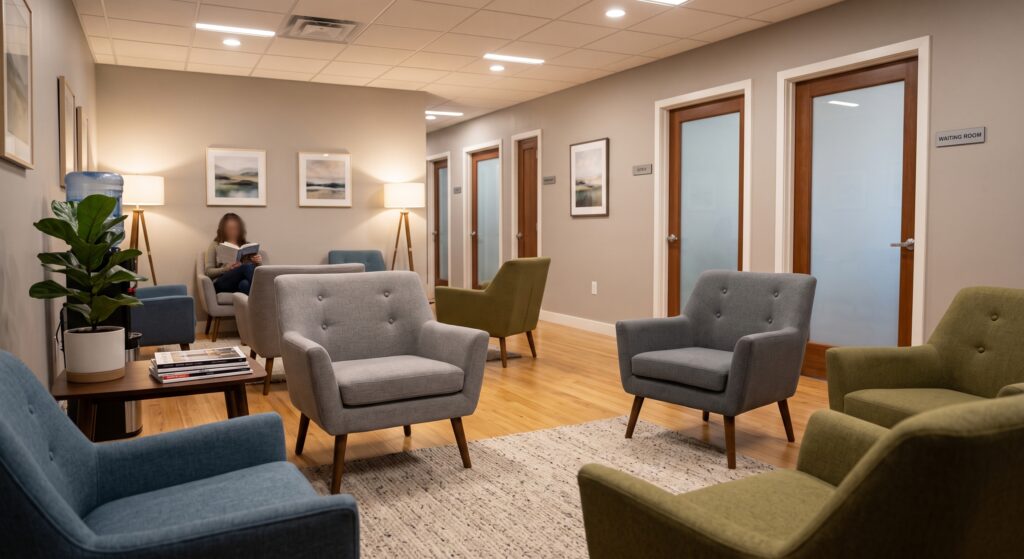
Shared waiting areas create a genuine clinical issue: two of your clients, or your client and a neighbor’s, occupying the same small room. Bergen County is a dense area where people know each other, and a chance encounter in a waiting room can end a therapeutic relationship.
Practical mitigations, in order of effectiveness:
- Staggered scheduling — build a 10 or 15 minute buffer between sessions so arrivals and departures don’t overlap
- Text-on-arrival — clients wait in their car and you message when the room is ready
- A second exit route where the building layout allows a client to leave without passing the waiting area
- Seating arrangement — a waiting area with dispersed seating beats a row of chairs facing each other
Ask which providers occupy the neighboring suites. A floor of independent practitioners in varied specialties creates far less exposure than a floor where everyone does the same thing.
Records, Devices, and Physical Safeguards
The HIPAA Security Rule requires covered entities to implement physical safeguards limiting access to systems and facilities housing electronic protected health information. The HHS summary of the Security Rule covers facility access controls, workstation security, and device and media controls.
In a rented suite, translate that into concrete questions:
- Who holds keys or access credentials to your suite, and is a log maintained?
- Does cleaning staff enter your suite, and when?
- Can you install your own lock on a file cabinet or storage closet?
- Is the WiFi network shared with other tenants, and is a private connection available?
- Does the building use a video intercom so you control who enters?
Secure 24/7 access with individual credentials solves most of this. A building where a master key circulates freely does not.
Lease Terms That Fit a Growing Caseload
New practices misjudge ramp time in both directions. Some sign long terms out of optimism and spend a year paying for space they can’t fill. Others take arrangements so short they get displaced right as the caseload stabilizes.
The Math Worth Running First
Work through four numbers before you negotiate:
- Target weekly sessions. How many client hours does your income goal require at your fee?
- Realistic ramp. From a standing start, six months to fill is fast and twelve is common. Referral relationships take time to produce.
- Carrying cost across the ramp. Rent multiplied by ramp months, plus insurance, licensure, and software.
- Available capital. What you can absorb before the practice covers itself.
If the numbers make you uneasy, the term is too long or the suite is too big. A single suite you outgrow in eighteen months is a far better outcome than a double you can’t fill in thirty-six. Our breakdown of medical office rental versus leasing covers the structural differences in more depth.
Terms Worth Asking For
- Early termination without penalty, or with a capped and clearly defined fee
- Right of first refusal on an adjacent suite so growth doesn’t force relocation
- Transfer rights between suite sizes inside the same building
- Part-time or shared-day arrangements if you’re starting alongside a W-2 position
- Delivery condition documented, including any landlord work finished before your start date
A landlord confident in the building will negotiate most of these. Blanket resistance tells you what you need to know.
What “All Inclusive” Should Actually Cover
The phrase appears in nearly every listing and means something different in each one. Get specifics in writing.
Confirm item by item:
- Utilities — electric, heat, cooling, water, with any usage caps stated
- Internet — speed, shared or private, and whether a dedicated line is available
- Cleaning — which areas, how often, and whether your suite interior is included
- Common areas — waiting area, restroom, kitchen or break room
- Furnishings — exactly what stays with the suite
- Signage — suite door and building directory listing
- Access hours — evenings and weekends included, or restricted
- On-site staff — present during what hours, and responsible for what
Evening and weekend access deserves particular attention in mental health. A large share of therapy clients book around a work schedule, and a building that locks down at six eliminates your most requested time slots. Confirm that after-hours entry works without you propping a door open.
Licensing and Business Setup in New Jersey
Space is one piece. Getting the practice itself established runs on a parallel track, and the timelines rarely line up neatly.
Which Board Governs You
New Jersey licenses mental health professionals through separate boards under the Division of Consumer Affairs:
- Social workers hold CSW, LSW, or LCSW credentials through the State Board of Social Work Examiners
- Professional counselors and associate counselors are licensed through the Professional Counselor Examiners Committee under the Board of Marriage and Family Therapy Examiners
- Psychologists are licensed through the State Board of Psychological Examiners
- Marriage and family therapists fall under the Board of Marriage and Family Therapy Examiners
No New Jersey board imposes a square footage requirement on a therapy office, which sets mental health apart from several other professions that rent small suites. Your obligations concern scope of practice, supervision where applicable, recordkeeping, and continuing education.
Sequence Matters
Order of operations saves money:
- Confirm licensure is active and in good standing
- Form the business entity and obtain an EIN
- Secure professional liability insurance
- Sign the lease
- Apply for insurance panel credentialing if you plan to take insurance
- Set up practice management software and telehealth infrastructure
Credentialing is the long pole. Panel applications routinely take three to six months, and starting them before you have a practice address creates rework. Signing a lease slightly ahead of credentialing is usually the right call, since the address is a prerequisite.
Location Factors That Affect Attendance
Clients cancel for reasons that have nothing to do with therapy. Friction in reaching you shows up directly in your no-show rate.
Parking and Access
Bergen County parking varies block by block. Downtown business districts mix metered street parking with municipal lots, and ten minutes of circling turns a weekly client into a biweekly one. Walk the block at the hour your clients would arrive — not midday on a Tuesday when the tour happened to be scheduled.
Check the path from the parking spot to your door. Stairs, long exposed walks in winter, and confusing building entries all add friction. Elevator access matters for older clients and anyone with mobility limitations.
Proximity to Referral Sources
Referral flow follows geography more than clinicians expect. Being within a short drive of primary care offices, pediatric practices, schools, and psychiatric prescribers produces referrals that never materialize from a location twenty minutes further out.
A building housing other independent healthcare providers creates the same effect internally. Our post on why Englewood works well for a practice covers the referral and demographic picture for the area.
A Tour Checklist for Clinicians
Bring this and work through it in the room.
Test
- Sound transmission through each shared wall and the door
- Cell signal and WiFi speed inside with the door closed
- Whether HVAC noise is loud enough to intrude, or usefully masks corridor sound
- Natural light and whether you can control it
Measure
- Room dimensions against your furniture plan
- Distance from suite to restroom and building entry
- Waiting area capacity and seating layout
Ask
- Which providers occupy neighboring suites
- After-hours and weekend access policy
- Who enters your suite and when
- How maintenance requests are handled and typical response time
- Whether a door upgrade or added insulation is negotiable
Red Flags
- A landlord who has never rented to a mental health provider and hasn’t considered sound
- No written inventory of what conveys with the suite
- Waiting area shared with a high-traffic business
- Access hours ending before 7pm
- Pressure to sign during the tour
Take the list with you and book a tour at anywhere you’re seriously considering.
Frequently Asked Questions
How much space does a solo therapist need?
Most individual practices work comfortably in 180 to 240 square feet, which accommodates two chairs, a side table, a small desk, storage, and circulation. Couples and family work, play therapy, and assessment practices generally need a double suite in the 325 to 470 square foot range.
Does New Jersey require a minimum office size for therapy practice?
No. No mental health licensing board in New Jersey imposes a square footage requirement on a private practice office. Requirements concern licensure, scope of practice, supervision, and recordkeeping rather than facility dimensions.
Is a shared waiting room a HIPAA problem?
Not inherently. HIPAA requires reasonable safeguards rather than perfect isolation. Practical measures — staggered scheduling, text-on-arrival, and dispersed seating — address the realistic exposure. The greater concern is clinical rather than regulatory: a client who encounters someone they know may disengage from treatment.
What should I ask about soundproofing before signing?
Ask whether the door is solid-core, whether seals and a sweep are installed, what the shared walls are constructed from, and whether the landlord will upgrade the door or add insulation as a condition of the lease. Test transmission yourself during the tour instead of relying on a description.
Can I see clients in the evenings and on weekends?
Depends on the building. Confirm access hours in writing before signing, since evening availability drives a large share of therapy demand. Buildings with secure individual credentials and video intercom entry generally accommodate after-hours work without difficulty.
How long a lease should a new private practice sign?
Match the term to your ramp. Filling a caseload from a standing start typically takes six to twelve months, so a term with an early termination provision or a shorter initial period protects you if referral flow develops slower than projected.
Do I need my own liability insurance if the building carries coverage?
Yes. A landlord’s policy covers the premises, not your clinical practice. Professional liability coverage is separate and is your responsibility regardless of what the building carries.
Can two clinicians share one suite?
Two clinicians can share a suite by splitting days or hours, and the arrangement is common among part-time practitioners. Put the schedule, the storage division, and the payment structure in writing, and confirm the lease permits it before you commit.