
Table of Contents
- Aesthetic Suite Rental in Bergen County, NJ: What the Search Actually Involves
- The Two Licensing Paths, Side by Side
- Space Requirements That Depend on Your License
- What the Room Itself Needs to Support Your Work
- What “All Inclusive” Should Cover
- Lease Terms That Match a Building Practice
- Location Factors That Affect Whether Clients Show Up
- A Practical Tour Checklist
- Frequently Asked Questions
Key Takeaways
- Aesthetic suite rental in Bergen County, NJ splits into two regulatory paths — skin care specialty and physician-supervised medical aesthetics — and each one carries different space requirements.
- New Jersey sets a 350 square foot minimum for a licensed skin care specialty premises. Providers on the medical side have no state square footage rule.
- Confirm your licensing path first, then match the suite size to it. Signing a lease before you know which category you fall under is the most expensive mistake in this process.
Aesthetic Suite Rental in Bergen County, NJ: What the Search Involves
Aesthetic suite rental in Bergen County, NJ draws two very different tenants who use the same search terms. One is a licensed esthetician who wants to leave a salon or spa and run her own skin care business. The other is a nurse practitioner, PA, or physician offering aesthetic services under medical licensure. Both need a private treatment room, a sink, secure storage, and a professional address. Only one of them has a state-mandated floor area.
Most listings ignore the distinction completely. A commercial broker will show you a 250 square foot room and tell you it’s perfect for skin care, because a broker has no reason to know Title 13, Chapter 28 of the New Jersey Administrative Code. The consequence lands on the tenant, who signs, applies for a shop license, and gets told the premises doesn’t qualify.
Who Rents Small Aesthetic Suites in North Jersey
The tenant mix in Bergen County breaks down roughly like this:
- Licensed estheticians (600-hour skin care specialty license) opening independent treatment rooms
- Permanent makeup and micropigmentation artists, who may hold cosmetology credentials plus separate training
- Nurse practitioners and physician assistants offering aesthetic services within their scope
- Physicians running part-time aesthetic practices alongside a primary specialty
- Laser technicians operating under physician supervision
- Massage therapists and holistic providers adding aesthetic services as a second revenue line
Each group answers to a different board. Sorting out which one applies to you takes an afternoon and saves months.
The Question to Answer Before You Tour Anything
Ask yourself: does my business require a shop license from the New Jersey State Board of Cosmetology and Hairstyling? If yes, the premises has a minimum size and a fixed equipment list. If no, you’re renting a professional office and the rules that govern you concern scope of practice, supervision, and recordkeeping — not floor area.
Everything else in your search depends on that one answer. Suites at SADA Med Suites come as singles at 180 to 240 square feet and doubles at 325 to 470, so the answer determines which inventory you should even be looking at.
The Two Licensing Paths, Side by Side
New Jersey draws a hard line between cosmetic skin care and medical aesthetic practice. Providers cross that line constantly without realizing it, usually because a service they learned in a weekend certification course turns out to sit on the medical side.
| Skin Care Specialty | Medical Aesthetics | |
| Governing board | Board of Cosmetology and Hairstyling | Board of Medical Examiners / Board of Nursing |
| Practitioner credential | 600-hour esthetics program, state exam | MD, DO, NP, PA, RN with appropriate scope |
| Premises license required | Yes — shop license | No shop license |
| State minimum floor area | 350 sq ft | None specified |
| Equipment mandated by rule | Yes — specified list | Determined by services offered |
| Renewal cycle | Biennial, even-numbered years | Varies by board |
The Board of Cosmetology and Hairstyling licensing page lays out individual credential requirements. Shop licensure is a separate application entirely, and plenty of new practitioners assume their personal license covers the business. It doesn’t.
Where Providers Get Caught
A few patterns come up repeatedly in Bergen County:
- An esthetician adds a service that requires medical oversight. The individual license stays valid; the service moves outside its scope.
- A nurse opens an aesthetic practice and applies for a cosmetology shop license she doesn’t need. Wasted application, wasted months.
- Two providers share one room and split the rent. Under N.J.A.C. 13:28-2.8, a shop license holder cannot lease or sublease space on the licensed premises to a non-employee for skin care specialty services. Arrangements known as chair or booth rentals are prohibited in New Jersey outright.
Point three matters for how you structure any shared arrangement. Renting your own suite directly from a commercial landlord is a different legal structure than renting a room inside someone else’s licensed shop. The first is a standard commercial tenancy. The second is not permitted.
Space Requirements That Depend on Your License
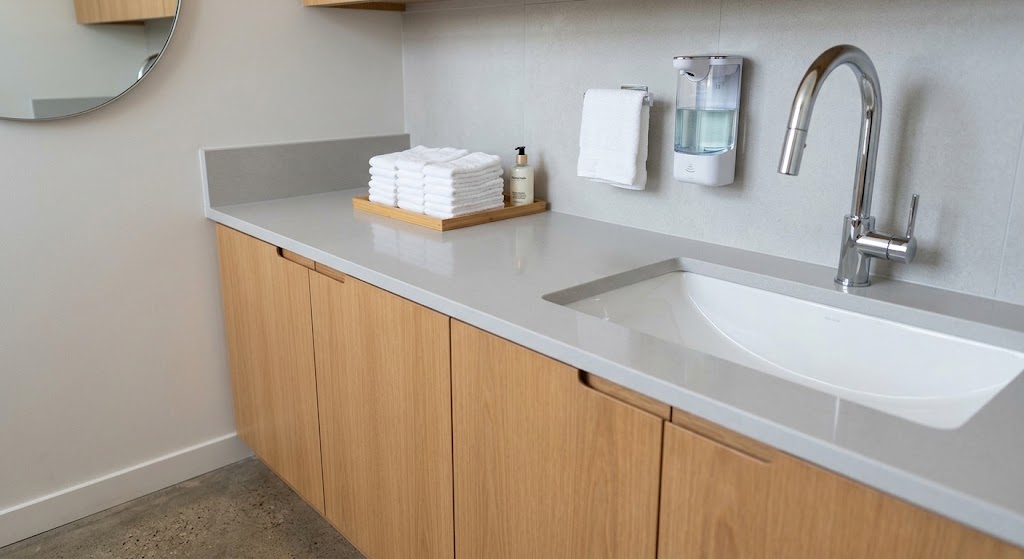
If you need a skin care specialty shop license, the physical standard comes from N.J.A.C. 13:28-2.6A, which incorporates the requirements at 13:28-2.5(a). The premises must contain at least 350 square feet of floor space, plus a lavatory with a toilet, hand washing facilities, and a door.
Beyond floor area, the regulation requires every licensed skin care specialty shop to have:
- At least one sink in the work area with hot and cold running water
- A designated area for cleaning and disinfecting implements and tools
- One ultrasonic unit for cleaning metal implements
- A clean, closed receptacle for sanitized implements at each work station
- A closed container for clean linens and a separate closed container for soiled linens
- A closed waste container at each work station
- A dispensary where supplies are prepared and dispensed
- Whatever additional equipment the services offered require to be performed safely
Reading the Requirement Against Real Suite Sizes
Here’s how the numbers land against typical small-suite inventory:
| Suite type | Typical size | Skin care specialty shop | Medical aesthetics |
| Single | 180–240 sq ft | Below the 350 sq ft threshold | Workable |
| Double | 325–470 sq ft | Qualifies at 350 and above | Workable |
Estheticians pursuing shop licensure should be looking exclusively at doubles, and should confirm the measured square footage in writing before signing anything. The state application requires a floor plan drawn to scale along with documentation that the municipality has approved the premises for business use, per the shop license application instructions. A landlord who won’t put dimensions in the lease is a landlord you should walk away from.
Providers on the medical side have far more freedom. A single suite handles consultations, treatment, and charting comfortably for a solo practitioner seeing six to ten clients a day. Our post on 10 things to look for before renting a medical office suite covers the general evaluation criteria that apply regardless of which path you’re on.
What the Room Itself Needs to Support Your Work
Regulation sets the floor. Practical function sets everything above it. Walk into any suite you’re considering and evaluate it against how you work, not how it photographs.
Plumbing and Power
An in-suite sink changes your entire workflow. Without one, every hand wash and every implement rinse means leaving the room, walking a corridor, and coming back — repeated forty times a day. Confirm hot water reaches the tap at a usable temperature within a reasonable wait, not just that a faucet exists.
Electrical capacity deserves the same scrutiny. Treatment equipment, a steamer, magnification lighting, a laptop, and a space heater on the same circuit will trip a breaker mid-session. Ask which outlets sit on which circuits and whether the building can add a dedicated line if your equipment demands one.
Light, Climate, and Sound
Overhead fluorescent light makes skin assessment unreliable and makes clients look worse than they are. Look for adjustable task lighting and, ideally, natural light you can control.
Private climate control per suite is worth more than most tenants expect. Clients lying still under a drape get cold. A building-wide thermostat set for people in blazers works against you all winter.
Sound carries through shared walls. Stand in the suite while someone speaks at conversational volume in the adjacent room. Whatever you hear, your client hears too.
Storage and Setup
Product inventory, linens, disposables, and client files all need a home. Measure the storage before you fall in love with the room. A treatment table, a rolling stool, a cart, and a small desk consume floor area faster than a floor plan suggests.
What “All Inclusive” Should Cover
The phrase gets used loosely across commercial listings. Pin down specifics in writing before you sign.
Ask the landlord to confirm, item by item:
- Utilities — electric, water, heat, and cooling, with any usage caps stated
- Internet — speed, whether the network is shared, and whether a private connection is available
- Cleaning — which areas, how often, and whether your suite interior is included
- Common areas — waiting area, restroom, kitchen or break room, and who maintains them
- Furnishings — what conveys with the suite and what you supply
- Signage — whether your business name appears on the suite door and building directory
- Access — hours, key or fob system, guest entry, and whether after-hours use costs extra
- Trash — general waste handling, and separately, whether the building accommodates regulated waste if your services generate any
Regulated waste deserves a specific conversation. A general commercial landlord may have no arrangement for it, which leaves you contracting independently. Providers performing services that produce sharps or contaminated materials should settle this before move-in, not after.
Fully furnished suites shorten the runway considerably. Our guide to turnkey medical office suites walks through what move-in ready should mean in practice.
Lease Terms That Match a Building Practice
New practices misjudge ramp time in both directions. Some sign five-year terms out of optimism and spend year two paying for space they can’t fill. Others take month-to-month arrangements and get displaced right as their client base stabilizes.
Matching Term to Revenue Reality
Run the math before you negotiate:
- Count how many treatment hours per week your target income requires.
- Estimate honestly how long filling that schedule will take from a standing start — six months is typical, twelve is common.
- Calculate what carrying the space costs across that ramp period.
- Compare that figure to your available capital.
If the answer makes you uncomfortable, the term is too long or the suite is too large. A single suite you outgrow in eighteen months is a better problem than a double you can’t fill in thirty-six.
Terms Worth Negotiating
- Early termination without penalty, or with a defined, capped fee
- Right of first refusal on the adjacent suite, so growth doesn’t mean relocation
- Transfer rights between suite sizes within the same building
- Escalation caps if the term runs beyond a year
- Delivery condition spelled out, including any landlord work completed before the start date
A landlord confident in the building will negotiate on most of these. Resistance across the board tells you something.
Location Factors That Affect Whether Clients Show Up
Aesthetic clients rebook on convenience as much as results. Friction in getting to you turns a weekly client into a monthly one.
Parking and Access in Bergen County
Bergen County parking varies block to block. Downtown business districts often mix metered street parking with municipal lots, and the difference between a client circling for ten minutes and pulling straight in shows up in your retention numbers. Walk the block at the hour your clients would arrive, not at noon on a Tuesday when the tour was scheduled.
Evening and weekend access matters more in aesthetics than in most professional services. Clients book around work. Confirm the building permits after-hours entry and that a secure system — fob access, video intercom — lets you admit clients without propping a door.
The New York Factor
Bergen County sits minutes from upper Manhattan and the Bronx across the George Washington Bridge. Providers relocating from New York frequently keep a portion of their client base, and clients who once paid Manhattan parking rates find a Bergen County appointment easier rather than harder. Our post on why Englewood is a strong location for a practice covers the demographic and access picture in more detail.
Foot traffic around an established retail district also supplies walk-in inquiries that an office park never will. Position matters for a business that grows on visibility.
A Practical Tour Checklist
Bring this list and work through it in the room.
Measure and verify
- Actual square footage, confirmed and put in writing
- Ceiling height and door width for equipment delivery
- Distance from suite to restroom and to building entry
Test
- Water temperature and pressure at the sink
- Sound transmission through each shared wall
- Cell signal and WiFi speed inside the room with the door closed
- Lighting quality against a skin tone, not a wall
Ask
- Which other providers occupy the floor and what they offer
- Whether the landlord holds any professional license that governs the premises
- How maintenance requests get submitted and what the response time is
- What the building’s history is with tenants in your specialty
Red Flags
- Square footage quoted as “about” or “roughly”
- No written inventory of what conveys with the suite
- A landlord unfamiliar with the licensing requirements of the tenants he markets to
- Shared treatment equipment with no written protocol for cleaning responsibility
- Pressure to sign at the tour
A building that serves professional tenants well will answer all of it without flinching. Reach out for a tour and bring the list.
Frequently Asked Questions
Can an esthetician rent a single suite in New Jersey?
Not for a business requiring a skin care specialty shop license. N.J.A.C. 13:28-2.6A incorporates the 350 square foot minimum at 13:28-2.5(a), which puts single suites of 180 to 240 square feet below the threshold. Estheticians pursuing shop licensure should look at double suites of 350 square feet or larger and confirm measured dimensions in writing before signing.
Do nurse practitioners offering aesthetic services need a cosmetology shop license?
No. Providers practicing within medical licensure answer to the Board of Medical Examiners or the Board of Nursing depending on credential, and no cosmetology shop license applies. Scope of practice, physician oversight where required, and recordkeeping obligations govern instead. Confirm your specific requirements with your licensing board.
Is booth rental legal in New Jersey?
No. N.J.A.C. 13:28-2.8 prohibits a shop license holder from leasing or subleasing space on licensed premises to a non-employee for skin care specialty or related services. Chair and booth rentals are named specifically. Renting your own suite directly from a commercial landlord is a separate arrangement and is not covered by that prohibition.
How long does a shop license application take in New Jersey?
Timelines vary with application completeness and inspection scheduling. Applications require a scale floor plan and documentation that the municipality has approved the premises for business use, so gathering materials often takes longer than the review itself. Start the process well before your intended opening date.
What size suite fits a solo aesthetic provider?
A single suite of 180 to 240 square feet accommodates a treatment table, cart, storage, and a small work surface for one provider on the medical path. Providers needing shop licensure, or anyone planning a second treatment station, should size up to a double.
Can two providers share one suite?
Depends entirely on the structure. Two providers on separate leases holding separate credentials operate as separate businesses. An arrangement where one licensed shop holder rents space to a non-employee for skin care services is prohibited under New Jersey rule. Have an attorney review any shared arrangement before it starts.
What should be included in an all-inclusive aesthetic suite rental?
At minimum: utilities, internet, cleaning of common areas, waiting area access, restroom access, and furnishings. Ask specifically about signage, after-hours access, and any waste handling your services require, since those three are the most common omissions.
Does the building need its own license for my practice?
Generally no for a commercial landlord renting professional office space. The license attaches to your business and your premises. Confirm the landlord will support your application with documentation the state requires, including floor plans and proof of municipal business approval.