Key Takeaways
- Medical office space for rent in Fort Lee, NJ commands a premium driven by density, bridge access, and limited commercial inventory — worth understanding before you commit.
- Fort Lee’s patient base is unusually strong for healthcare: 25.2% of residents are 65 or older, and just over half are foreign-born, per Census data.
- Parking is the constraint most providers underestimate. Evaluate it before square footage, price, or finishes.
Medical Office Space for Rent in Fort Lee, NJ: The Full Picture
Providers searching for medical office space for rent in Fort Lee, NJ are usually drawn by the same two facts: the borough sits directly at the New Jersey foot of the George Washington Bridge, and it holds one of the densest, most healthcare-active populations in Bergen County. Both are real advantages.
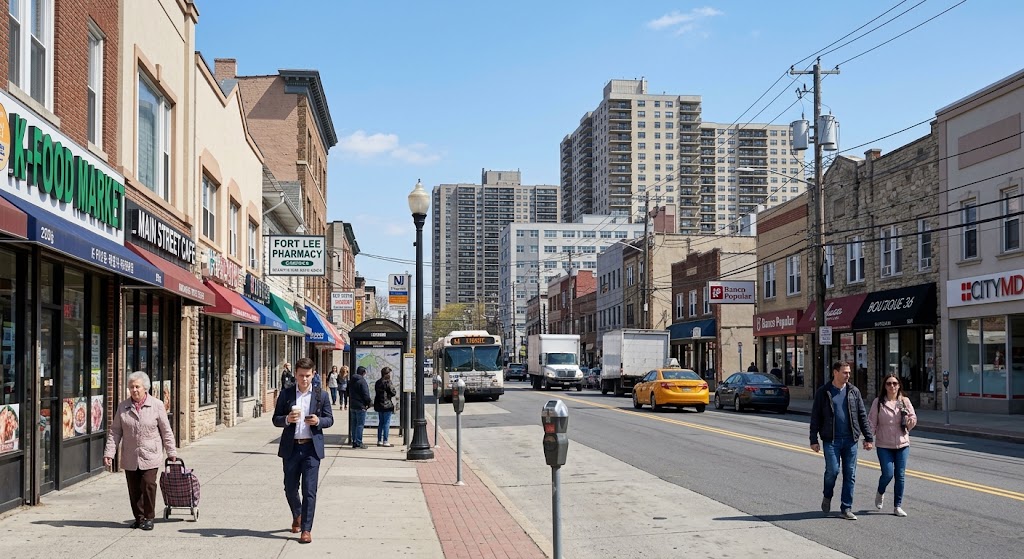
What the search turns up is thinner than the demand suggests. Fort Lee covers roughly 2.5 square miles with a population above 40,000, which produces very high residential density and correspondingly little ground available for commercial development. Most of what exists is either ground-floor retail along Main Street and Lemoine Avenue, or professional space inside mixed-use high-rise buildings.
Small clinical suites — the 180 to 470 square foot range that suits a solo or two-provider practice — are the hardest category to find anywhere in the borough.
Why the Patient Base Is Genuinely Strong
Census figures make the case better than any listing description. According to Census Bureau QuickFacts for Fort Lee borough:
- Population of 40,191 as of the 2020 Census
- 25.2% of residents are 65 or older, well above state and national rates
- 44.1% identify as Asian alone, with a large and long-established Korean-American community
- 50.4% of residents are foreign-born
The age profile matters most. A quarter of the population in the highest healthcare-utilization bracket, concentrated within two and a half square miles, is an unusual concentration of demand.
The foreign-born share matters nearly as much. Multilingual providers, particularly Korean-speaking practitioners, find a patient base in Fort Lee that exists in few other places in the region. Language capability functions as a competitive advantage rather than a nice-to-have.
What Fort Lee Space Actually Costs You
Rent is the obvious number. The less obvious costs are the ones providers discover in month three.
The Parking Problem
Fort Lee parking is genuinely difficult, and the difficulty falls on your patients rather than on you. Metered street parking turns over slowly. Municipal lots fill. High-rise buildings often reserve garage space for residents, leaving visitors to search.
For a practice serving patients over 65, parking is not a minor inconvenience. It’s the difference between a patient who keeps appointments and one who reschedules until they stop.
Evaluate honestly before signing:
- Where does a patient park at 10am on a Tuesday, not at the hour of your tour?
- How far is the walk, and is any of it covered?
- Is the building entry obvious from the parking area?
- Where does a patient with mobility limitations park?
- Does the building offer validated or dedicated visitor parking?
Walk it twice on different days. A landlord’s assurance about parking availability is worth exactly nothing against your own observation.
Bridge Traffic Runs Both Directions
Bridge proximity cuts both ways. Access from upper Manhattan and the Bronx is genuinely fast outside peak hours. During peak hours, the approach roads that make Fort Lee convenient become the reason patients arrive late or not at all.
Schedule accordingly. Mid-morning and early-afternoon slots reliably outperform 8am and 5pm for anyone crossing the bridge, and telling patients so directly improves attendance.
Inventory Realities
The small-suite shortage produces predictable consequences. Providers end up taking larger space than they need, splitting a unit with another practice informally, or accepting a location with poor patient access because it was what came available.
None of the three is a good outcome for a practice in its first two years.
Where to Look Beyond the Borough Line
A search limited to Fort Lee’s municipal boundary rules out inventory a few minutes away that often serves the same patients better.
Englewood, Ten Minutes North
Englewood sits a short drive up Route 4 and Palisade Avenue, and the tradeoffs favor small practices in several ways:
| Fort Lee | Englewood | |
| Small suite inventory | Scarce | Available |
| Parking | Constrained | Municipal lots, street parking |
| Bridge access | Immediate | Short drive |
| Building type | High-rise mixed-use | Downtown professional |
| Foot traffic | Retail corridor | Shopping and business district |
Patients who already drive to appointments — which describes most of Fort Lee’s over-65 population — experience the additional distance as minimal. Patients who currently circle for parking experience the change as an improvement.
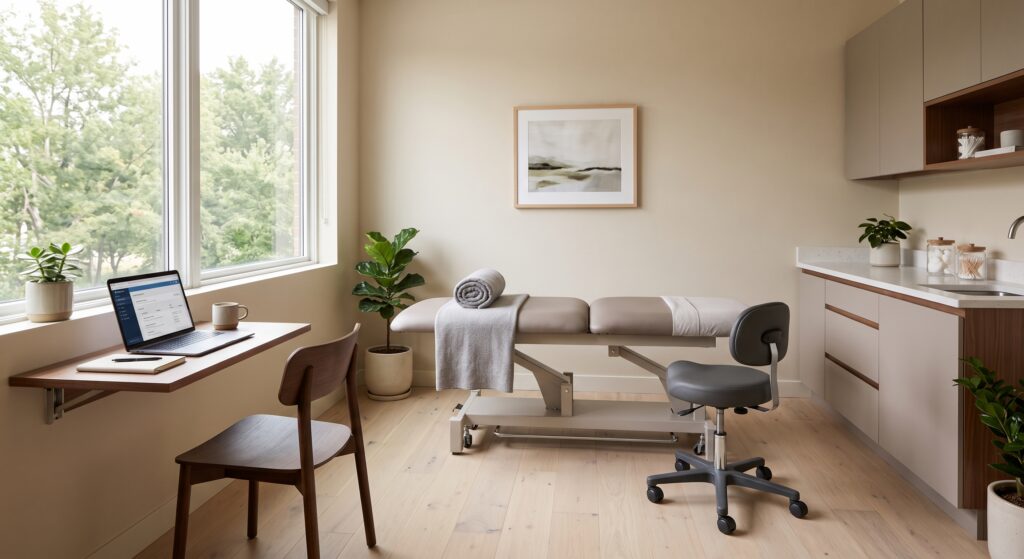
Fully furnished suites at SADA Med Suites run 180 to 240 square feet as singles and 325 to 470 as doubles, in a downtown location with municipal parking nearby. Our page on the Englewood location covers the specifics.
Other Nearby Options
Edgewater and Cliffside Park sit along the waterfront corridor with newer mixed-use development. Leonia and Palisades Park offer smaller professional buildings. Teaneck and Bergenfield sit further from the bridge but closer to hospital campuses.
Each trades bridge proximity for something else. Decide which variable your practice depends on before you rule any of them out.
What to Verify in Any Fort Lee Building
If a Fort Lee suite is the right answer, the building itself needs scrutiny that a standalone medical office wouldn’t require.
Mixed-Use Complications
Professional space inside residential high-rises carries specifics worth confirming:
- Patient entry — do patients use the residential lobby, and is a doorman involved?
- Elevator access — shared with residents, and how does it perform at peak times?
- Building hours — can you offer evening appointments?
- Signage rights — will your practice name appear on the building or only a directory?
- Condo or co-op rules — boards often restrict commercial use in ways a lease doesn’t disclose
- Deliveries — where do supplies arrive, and who accepts them?
Confirm the certificate of occupancy permits medical use specifically. Professional office use and medical office use are separate classifications in many municipalities, and discovering the difference after signing is expensive.
Infrastructure
Older buildings along the Main Street corridor were not built for clinical tenants:
- Electrical capacity for equipment beyond a computer
- Plumbing for an in-suite sink, and whether adding one is permitted
- HVAC control per unit rather than building-wide
- Sound transmission between units
- Regulated waste handling arrangements
Ask about each before you fall for the room. Our checklist of 10 things to look for before renting a medical office suite covers the general evaluation in more depth, and our guide to turnkey suites explains what move-in ready should include.
Licensing and Setup for Providers New to New Jersey
A large share of providers searching Fort Lee are coming from New York, where the bridge makes the move practical.
New Jersey licensure is a separate application. Physicians and podiatrists apply through the State Board of Medical Examiners, which also licenses several allied health professions. Nurses go through the Board of Nursing, dentists through the Board of Dentistry, and mental health clinicians through their respective boards, all under the Division of Consumer Affairs.
Sequence matters:
- New Jersey licensure — the longest item, start it first
- CDS registration if you prescribe
- DEA registration tied to your practice address
- Prescription Monitoring Program enrollment
- New Jersey malpractice coverage
- Insurance panel credentialing at the practice address
Credentialing runs three to six months and requires an address, which is why the lease sits ahead of it rather than behind. New Jersey plan contracts are separate from New York contracts even under identical carrier names.
Building a Patient Base in a Dense Market
Fort Lee’s density is an advantage and a competitive pressure at once. A lot of providers already serve this population.
What Differentiates
- Language capability, particularly Korean, opens a patient base that competitors cannot reach
- Appointment availability outside standard hours, given the commuter population
- Referral relationships with the primary care practices already established in the corridor
- Google Business Profile established early, since local rankings take months to mature
- Specialty depth rather than general coverage in a market that already has generalists
What Doesn’t
Competing on convenience alone rarely works in a market where a patient can walk to three alternatives. Competing on price erodes margin without building loyalty. Providers who succeed here tend to offer something specific that the corridor lacks.
Whichever side of the borough line you land on, the patient base is the reason to be here. Book a tour and evaluate the space against the checklist rather than the listing photos.
Frequently Asked Questions
Is Fort Lee a good location for a medical practice?
The patient base is strong — high density, a large population over 65, and a substantial multilingual community. Constraints are inventory and parking. Small clinical suites are scarce, and patient parking is the most common operational complaint from practices already there.
How much does medical office space cost in Fort Lee?
Rates vary considerably by building type, floor, and whether the space is furnished. Bridge proximity and limited inventory push Fort Lee above much of Bergen County. Compare total occupancy cost — including any buildout, furnishing, and utilities — rather than base rent alone.
What size suite does a solo provider need?
A single suite of 180 to 240 square feet handles a full day of consultations or visits, fitting an exam or treatment table, seating, storage, and a work surface. Procedural practices and multi-provider setups generally need 325 to 470 square feet.
Can I open a medical office inside a Fort Lee residential building?
Sometimes, with verification. Confirm the certificate of occupancy permits medical use specifically, and check condo or co-op board restrictions separately from the lease. Professional office use and medical office use are distinct classifications in many municipalities.
How far is Englewood from Fort Lee?
Roughly ten minutes by car depending on route and traffic. Patients who drive to appointments experience the difference as minimal, and parking availability frequently makes the trip easier overall than a closer location with no place to park.
Do I need a New Jersey license if I’m currently practicing in New York?
Yes. New York licensure does not transfer. Apply through the relevant New Jersey board under the Division of Consumer Affairs, and start early — licensure gates DEA registration, CDS registration, and insurance credentialing.
What languages should a practice support in Fort Lee?
Korean capability is the most significant differentiator given the borough’s demographics, with Spanish, Russian, and Japanese also represented. Just over half of Fort Lee residents are foreign-born, so multilingual front-desk support has measurable value.
How long does insurance credentialing take in New Jersey?
Three to six months is typical, and applications require a practice address. Begin as soon as the lease is signed. Cash-pay practices avoid the delay entirely, which is one reason behavioral health and aesthetic practices often open faster.
About SADA Med Suites
SADA Med Suites offers furnished private medical suites in downtown Englewood, roughly ten minutes north of Fort Lee and still minutes from the George Washington Bridge. Singles run 180 to 240 square feet, doubles 325 to 470, with utilities, internet, cleaning, and waiting area access included — and municipal parking nearby, which is the constraint Fort Lee providers name most often.
Patients who already drive to appointments experience the additional distance as negligible. Patients currently circling for parking experience it as an improvement.
Compare for yourself. See the suites or schedule a tour. Call (551) 230-7668 — 50 E Palisade Ave, Fl 2, Englewood, NJ 07631.