Key Takeaways
- Medical office space for rent in Bergen County, NJ varies sharply by town — household income, parking, hospital proximity, and small-suite availability all shift within a ten-minute drive.
- Three hospital corridors anchor the county’s medical real estate: Englewood, Hackensack, and Teaneck. Each produces a different tenant mix and a different cost structure.
- Small suites suited to solo and two-provider practices are scarce almost everywhere. Knowing which towns have them saves months of searching.
Medical Office Space for Rent in Bergen County, NJ: How to Narrow the Search
Providers searching for medical office space for rent in Bergen County, NJ face a county with 70 municipalities inside 234 square miles. Household incomes range from below the national median to well above $140,000 within a few miles of each other. Parking goes from municipal-lot easy to genuinely difficult over the same distance.
Searching the whole county at once produces noise. Searching one town rules out inventory fifteen minutes away that serves the same patients.
The practical approach sits between the two: identify which variable your practice depends on — hospital proximity, patient income, parking, bridge access, or small-suite availability — then filter towns against it.
The Variables That Separate Towns
| Variable | Matters most to |
| Hospital proximity | Specialists with privileges, referral-dependent practices |
| Household income | Cash-pay, aesthetic, concierge, elective services |
| Parking availability | Practices serving older patients, high-volume schedules |
| Bridge access | Providers relocating from New York |
| Small-suite inventory | Solo and two-provider practices |
| Language demographics | Multilingual providers |
Few practices need all six. Most need two or three, and being clear about which ones shortens the search dramatically.
Before You Filter Anything
Confirm what your licensing board requires of the premises. Physicians and podiatrists licensed through the State Board of Medical Examiners face no square footage minimum, and neither do mental health clinicians, chiropractors, or acupuncturists. Other New Jersey professions do — estheticians pursuing a skin care specialty shop license need at least 350 square feet of licensed premises, a requirement our guide to aesthetic suite rental in Bergen County covers in full.
Our post on which professionals can rent a medical suite breaks down who faces premises rules and who doesn’t. Sorting that out first prevents touring space you cannot legally occupy.
The Three Hospital Corridors
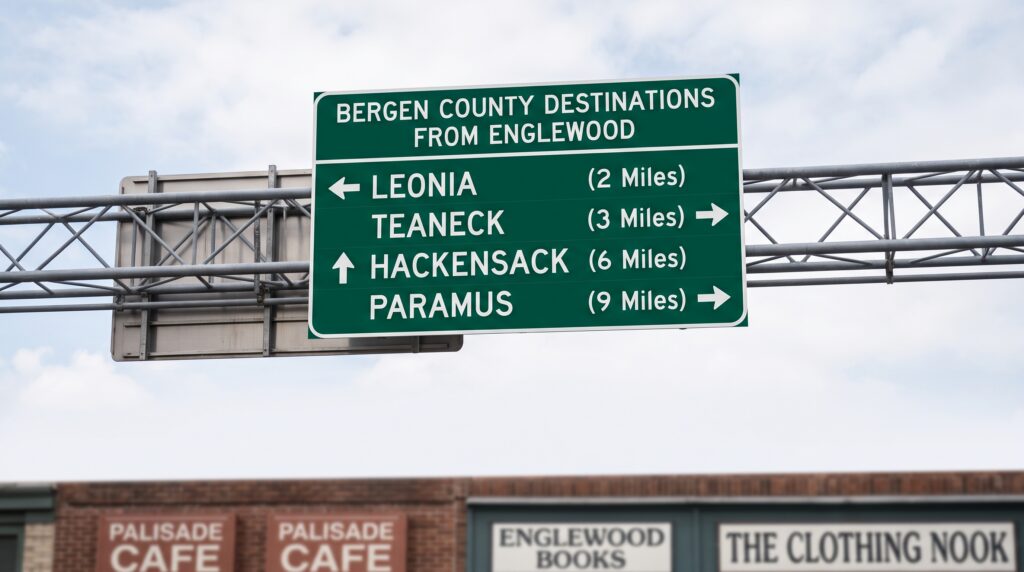
Medical real estate in Bergen County clusters around three anchors, and each corridor has its own character.
Englewood
Englewood Hospital at 350 Engle Street has operated since 1890 as a community teaching hospital, and merged into RWJBarnabas Health in January 2026. The surrounding downtown functions as a working commercial district rather than a medical office park.
Per Census Reporter, Englewood holds roughly 29,600 residents across 4.9 square miles — density above 6,000 per square mile — with median household income of $102,571 and a poverty rate of 9.21%, below the national figure.
Suits: practices wanting downtown foot traffic, municipal parking, bridge access, and small-suite availability in the same location.
Trade-off: a smaller hospital than Hackensack, which matters for specialties depending on high-acuity referral volume.
Our post on why Englewood works as a practice location covers the market in detail, and our location page covers the neighborhood.
Hackensack
Hackensack University Medical Center at 30 Prospect Avenue is among the largest hospitals in New Jersey — a Level I adult trauma center and teaching hospital affiliated with Rutgers New Jersey Medical School. Referral density around it is the highest in the county.
Hackensack holds roughly 45,800 residents with median household income of $84,277 and a foreign-born population above 42%, per Census Reporter. Healthcare and social assistance is the largest employment sector among residents.
Suits: specialists with hospital privileges, referral-dependent practices, multilingual providers.
Trade-off: small suites are scarce — the corridor was built for group practices — parking is competitive, and household income sits below the county picture.
Our full guide to medical office space for rent in Hackensack covers the corridor, the constraints, and the alternatives in detail.
Teaneck
Holy Name Medical Center at 718 Teaneck Road operates as a 361-bed not-for-profit facility founded in 1925, with roughly 4,000 employees and around 30,000 annual admissions. It runs deliberate community outreach programs, including a long-standing Korean medical program and Familia y Salud for Hispanic patients.
Teaneck carries median household income above $144,000 and a poverty rate near 5.6%, with a median age of 38.2 — younger than most surrounding towns.
Suits: family practice, pediatrics, women’s health, behavioral health, and cash-pay models supported by high household income.
Trade-off: predominantly residential, so commercial inventory concentrates on a few corridors, and small suites are limited.
Our guide to medical office space near Holy Name covers Teaneck and Bergenfield together, including the zoning and parking constraints both towns share.
The Bridge Towns
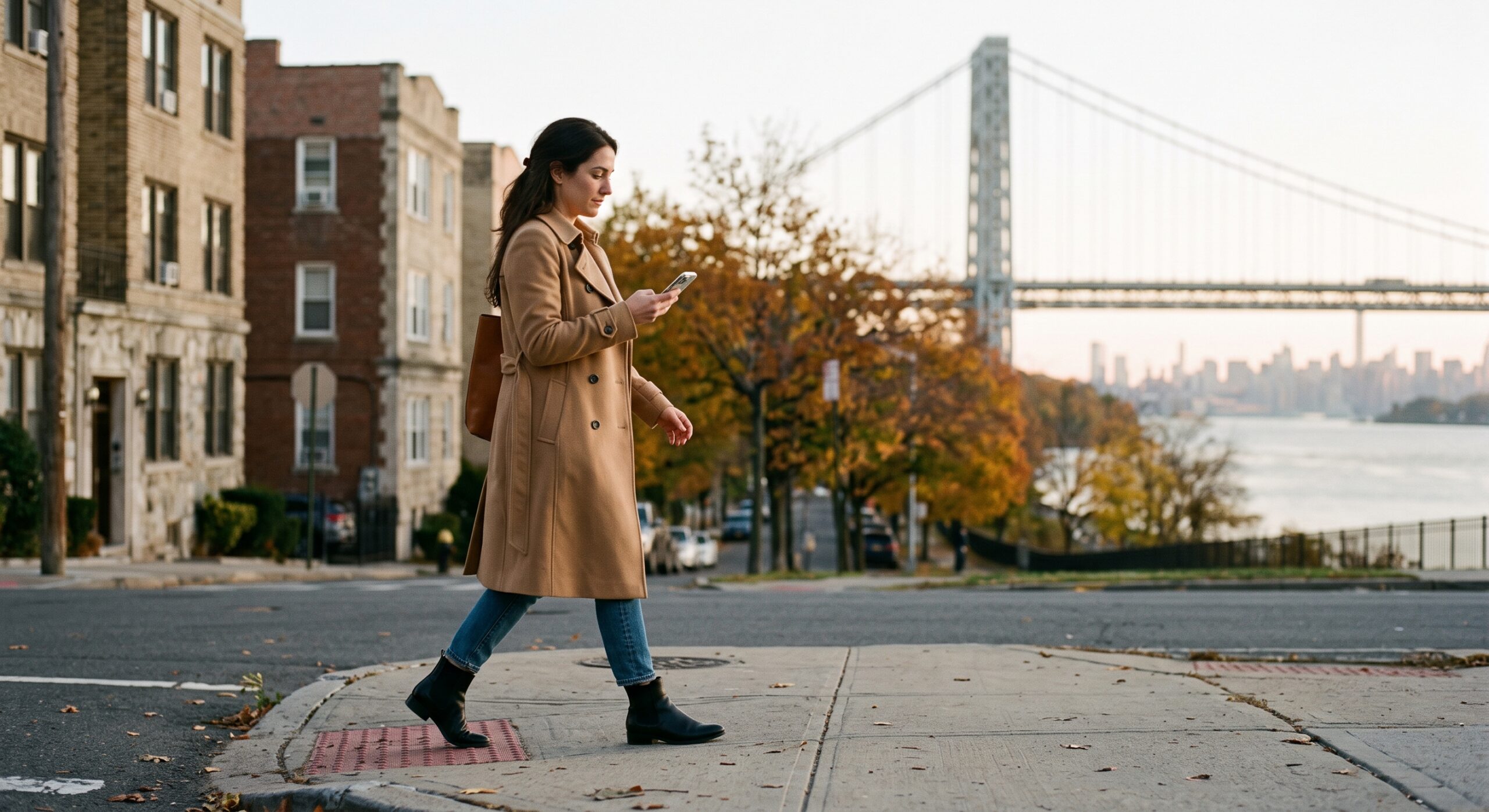
Proximity to the George Washington Bridge defines a second cluster with its own logic.
Fort Lee
Fort Lee packs 40,191 residents into roughly 2.5 square miles at the New Jersey foot of the bridge. Per Census Bureau QuickFacts, 25.2% of residents are 65 or older, 44.1% identify as Asian alone with a large Korean-American community, and 50.4% are foreign-born.
Suits: multilingual providers, particularly Korean-speaking, and practices serving an older patient base.
Trade-off: parking is the borough’s defining constraint, small-suite inventory is thin, and rates run high relative to the county.
Our full guide to medical office space for rent in Fort Lee covers the borough’s demographics and constraints, and our guide to medical office space near the George Washington Bridge covers the corridor for providers relocating from New York.
Edgewater and Cliffside Park
The Hudson waterfront corridor carries newer mixed-use development, high-rise residential, and ferry access to Manhattan. The population skews younger and more transient than inland Bergen County.
Suits: aesthetic and wellness practices serving a younger professional demographic.
Trade-off: commercial space sits mostly in residential buildings, which brings condo board restrictions and certificate of occupancy questions.
Leonia and Palisades Park
Smaller professional buildings at lower density, between Fort Lee and Teaneck. Palisades Park has one of the highest Korean-American population shares in the country.
Suits: providers wanting bridge proximity without Fort Lee’s costs, and multilingual practices.
Trade-off: thin inventory, and less foot traffic than a genuine downtown.
The Northern Valley and Western Towns
Higher incomes, lower density, different economics.
Tenafly, Cresskill, Closter, Demarest
The Northern Valley towns carry some of the county’s highest household incomes with low population density and predominantly residential zoning. Commercial space is limited by design.
Suits: established practices with a referral base already in place, elective and cash-pay services.
Trade-off: very limited inventory, longer catchment radius required, and little walk-in visibility.
Paramus
Retail-dominated, with newer commercial buildings and abundant parking. Route 4 and Route 17 run through it, making it reachable from across the county.
Suits: practices prioritizing parking and highway access over walkability.
Trade-off: office-park character with no neighborhood foot traffic, and heavy retail traffic at peak hours.
Bergenfield, Bogota, Ridgefield Park
Mid-density towns between the corridors. Bergenfield carries median household income around $120,500 at lower density than Teaneck. Bogota and Ridgefield Park offer smaller professional inventory at lower cost.
Suits: practices serving a local residential base without needing hospital adjacency.
Trade-off: less referral density, and limited commercial corridors.
Where Small Suites Actually Exist
The recurring problem across the county: inventory in the 180 to 470 square foot range that fits a solo or two-provider practice.
Most commercial medical space in Bergen County was built for group practices. A broker’s listings run to multi-thousand-square-foot floors, and a provider needing one room ends up choosing between space they cannot fill, a sublease from another practice, or a months-long wait.
What Providers End Up Doing
- Taking more space than needed and carrying it through a six-to-twelve month ramp
- Subleasing from an existing practice, where the host’s lease termination ends your tenancy
- Waiting for appropriate inventory to appear
- Signing a buildout they cannot afford in year one
None serves a practice in its first two years well. Our post on how many treatment rooms you need gives you the arithmetic to size a suite before you tour, which prevents most of those four outcomes. Our comparison of rental and leasing structures covers what each commitment obligates you to, and our guide to shared medical office space covers sublease exposure specifically.
The Furnished Suite Alternative
Buildings subdivided into individually leased furnished suites solve the inventory problem directly. Utilities, internet, cleaning, and common areas come bundled, and occupancy starts in days rather than months.
Downtown Englewood holds the most accessible concentration of this inventory in the county. SADA Med Suites offers singles at 180 to 240 square feet and doubles at 325 to 470 at 50 E Palisade Avenue, with municipal parking nearby.
Our guide to turnkey suites covers what the term should mean and how to hold any landlord to it, and our post on flexible medical office space in New Jersey covers why the model grew.
Comparing Towns Honestly
A framework rather than a ranking, since the right answer depends on your practice.
| Hospital access | Income | Parking | Bridge | Small suites | |
| Englewood | Good | High | Good | Short drive | Available |
| Hackensack | Excellent | Moderate | Competitive | Moderate | Scarce |
| Teaneck | Excellent | Very high | Variable | Short drive | Scarce |
| Fort Lee | Moderate | Moderate–high | Difficult | Immediate | Scarce |
| Edgewater | Moderate | High | Building-dependent | Short drive | Limited |
| Paramus | Moderate | High | Excellent | Longer | Limited |
| Northern Valley | Moderate | Very high | Good | Longer | Very limited |
Questions That Resolve the Choice
Does your practice need hospital adjacency, or just Bergen County? Specialists with privileges need the corridor. Behavioral health, aesthetics, and most cash-pay models do not, and paying the corridor premium buys proximity they never use.
How do your patients arrive? Driving patients treat a ten-minute difference as negligible and a ten-minute parking search as significant. Weight parking above distance.
What does your payer mix require? Cash-pay and elective services perform better where household incomes run high. Insurance-based practices have more flexibility. Our cost breakdown for opening a practice covers how payer mix affects the runway you need.
Does language capability differentiate you? Fort Lee and Palisades Park for Korean, Hackensack and Teaneck for Spanish, with Holy Name’s own outreach programs indicating where demand concentrates.
What does your specialty need from the room? Behavioral health needs sound privacy above all, which our guide to therapy office space in Bergen County covers, while nurse practitioners face their own considerations after the 2026 practice authority changes, addressed in our guide to office space for nurse practitioners.
What to Verify in Any Town
Consistent across the county.
- Certificate of occupancy permits medical office use specifically, since professional office use is a separate classification in many municipalities
- Zoning allows commercial use at that address, particularly in residential towns
- Premises requirements from your licensing board are satisfied by the space
- Parking observed yourself at your patients’ actual arrival hours, on two different days
- Access hours support evening and weekend appointments, stated in the lease
- Regulated waste handling arrangements exist, or plan to contract independently
- Measured square footage in writing, never “approximately”
Our tour checklist covers the full evaluation sequence, and our guide to starting a practice places the lease in the wider launch timeline — earlier than most providers expect, since insurance credentialing requires a practice address.
Two items worth settling with any landlord before signing: our HIPAA-compliant office setup checklist covers the access, cleaning, and network questions to ask, and our guide to setting up a Google Business Profile at a shared address covers the signage requirement worth confirming in the lease.
Frequently Asked Questions
Which Bergen County town is best for a medical practice?
Depends on what your practice needs. Hackensack offers the strongest referral density, Teaneck the highest household incomes, Fort Lee the closest bridge access, and Englewood the best combination of hospital proximity, parking, downtown visibility, and small-suite availability.
Where can I find small medical office suites in Bergen County?
Inventory in the 180 to 470 square foot range is scarce across the county, since most commercial medical space was built for group practices. Buildings subdivided into individually leased furnished suites are the most reliable source, with downtown Englewood holding the most accessible concentration.
How much does medical office space cost in Bergen County?
Rates vary widely by town, building type, and whether space is furnished. Hospital-adjacent and bridge-adjacent inventory commands a premium. Compare total occupancy cost — including buildout, furnishings, utilities, and pass-through charges — rather than base rent.
Which towns have the highest patient incomes?
Teaneck carries median household income above $144,000, and the Northern Valley towns run higher still. Englewood sits above $102,000, Bergenfield around $120,500, and Hackensack around $84,000.
Do I need a New Jersey license to practice in Bergen County?
Yes. Licensure does not transfer between states. Apply through the relevant board under the Division of Consumer Affairs, and start early — licensure gates DEA registration, CDS registration, and insurance credentialing.
Which towns are best for multilingual practices?
Fort Lee and Palisades Park for Korean-speaking providers, with more than 44% of Fort Lee residents identifying as Asian alone. Hackensack and Teaneck for Spanish, with Hackensack’s foreign-born population above 42%.
Is parking a real problem in Bergen County?
In some towns, yes. Fort Lee is the most constrained, and hospital corridors in Hackensack and Teaneck run competitive. Englewood and Paramus handle it better. For practices serving older patients, parking affects retention more than distance does.
How close is Bergen County to New York City?
Towns along the eastern edge sit minutes from the George Washington Bridge, putting upper Manhattan and the west Bronx within a short drive outside peak hours. Travel times vary considerably with bridge conditions.
About SADA Med Suites
SADA Med Suites rents private, fully furnished medical office suites to independently licensed practitioners at 50 E Palisade Avenue in downtown Englewood, New Jersey. Singles run 180 to 240 square feet and doubles run 325 to 470, with utilities, high-speed internet, cleaning, shared waiting area, in-suite sink, private climate control, video intercom entry, secure 24/7 access, and custom door signage included in one monthly payment.
Providers who have spent weeks finding nothing between a single shared room and a full commercial floor tend to find the search resolves quickly here — with municipal parking nearby, a short drive to the bridge, and measured square footage provided in writing. Tenants also appear in our provider directory.
Start with one tour. Browse available suites or book a visit. Call (551) 230-7668 — 50 E Palisade Ave, Fl 2, Englewood, NJ 07631.